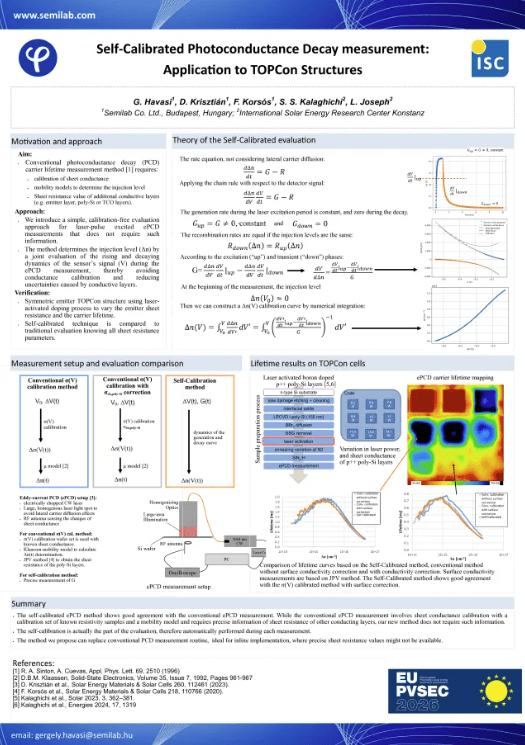
We improved the precision and the applicability of the widely used eddy-current-detected photoconductance decay (ePCD) carrier lifetime (τ) measurement method by applying a novel self-calibration method to calculate the injection level (∆n). The conventional PCD evaluation routine requires the calibration of the photoconductance using a resistivity calibration sample set and a carrier mobility model, which becomes particularly challenging for complex cell architectures and in the presence of conductive layers on the surface (e.g. emitter layer, poly-Si or TCO layers). We introduce a simple, calibration-free evaluation approach for laser-pulse excited ePCD measurement that does not require a mobility model or detailed information about the sample. The method determines ∆n by the evaluation of the dynamics of the sensor’s signal (V) during the ePCD measurement, thereby avoiding conductance calibration and reducing uncertainties caused by conductive layers. We demonstrate the approach on n-type TOPCon precursor samples fabricated using a novel laser-assisted poly-Si doping technique. The self-calibration algorithm provides ∆n(V), thus the recorded V(t) can be readily converted into ∆n(t), from which τ(∆n) can be standardly determined. τ(∆n) results are compared against the conventional procedure (including calibration and a mobility model). Our results show good agreement with the standard method, but without requiring information about wafer doping, mobility, sheet resistance of conductive layers. This feature can be particularly beneficial during industrial use. The proposed self-calibration approach is fast, does not require additional measurements, and is suitable for inline implementation.
主题
Carrier LifetimeTOPConPhotoconductance DecayCalibrationSilicon Materials and CellsCharacterisation & Modelling of Silicon Cells
作者
Gergely Havasi, Dávid Krisztián, Ferenc Korsós, Saman Sharbaf Kalaghichi, Lejo Joseph Koduvelikulathu